Anti-liberal Modernisation of the Soviet Union
The Armenian Case
Sachinformation
What is the unit about?
Between 1917 and 1924, Russia underwent a profound transformation, resulting in the creation of the Soviet Union. The February and October Revolutions of 1917 led to the collapse of the Russian Empire and the rise of the Bolshevik Party under Lenin, who promised ‘Peace, Land, and Bread’. Following the October coup, the Bolsheviks seized power, implementing reforms such as land redistribution and workers’ control of factories. However, these policies faced significant challenges, and caused chaos in agriculture and industry.
In response to the economic collapse, Lenin introduced the New Economic Policy (NEP) in 1921, allowing limited private enterprise, which stabilized the economy. The NEP was later replaced by Stalin's collectivisation policies in 1928, which focussed on rapid industrialisation and agricultural consolidation.
Soviet modernisation under Stalin was characterised by centralised planning, industrial growth, and social engineering. While modernisation garnered support from party loyalists, it also met fierce resistance from peasants, particularly during collectivisation. The state eventually resorted to brutal repression, including forced deportations, to maintain control.
This teaching unit approaches these issues using the Armenian example. Through the lens of liberalism, it reviews how modernisation took place, what propaganda tools were used and what economic and political conditions people lived through during those processes. The Armenian example provides an opportunity to review the main policies and approaches used throughout the Soviet Union as well as how central decisions were understood and carried out across the territory.
The unit is intended to expand lessons on the Soviet Union by going deeper into the practices and consequences.
Which materials are used?
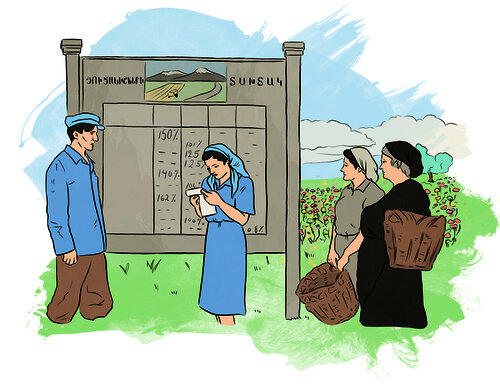
Within the five lessons, journal articles from various Soviet magazines from the late 1920s and early 1930s, including transcriptions and translations (materials 5-19, 22-36, 40-42, 44-46, 48-50 and 52-54), provide pupils with an inside perspective of the lived reality in Soviet Armenia. Although the articles are translated into English, the original texts are also included so that pupils with knowledge of the Armenian language can read them in the original language. Tasks and worksheets guide pupils in interpreting these historical sources (materials 20, 37, 43, 47, 51, 55 and 64). The inclusion of propaganda images (materials 21 and 38) prompts pupils to explore the messages conveyed by Soviet leaders. Excerpts from autobiographical texts (materials 56-62) help pupils to gain a deeper insight into the lived reality of that time. The materials are accompanied by worksheets which assist pupils in engaging with the sources. The authors have developed the worksheets in line with current research on the best approaches to developing active historical thinking. The aspect of resistance is explored through court cases of people who tried to oppose collectivisation (materials 56-63). These court cases are based on archival materials from the National Archive of Armenia.
The topic is introduced with the help of background information for the teacher (materials 1 and 3), a short video (material 2) and a text for informative purposes (material 4).
Sie können auch die gesamte Materialsammlung zusammen mit dem kompletten Text dieser Unterrichtseinheit herunterladen.